Aug 24, 2026 ● hireCNC
22 Machinists Asked About This Job. 71 More Made Sure Everyone Saw It.
James Tool had three CNC openings in Morganton, North Carolina.
Nothing exotic. A Prototrak mill and lathe machinist. A horizontal mill setup and programming guy. A lathe and mill setup and programming guy.
The kind of openings that sit unfilled for six months at shops all over the country.
We wrote the copy and built the graphic. Mara, the HR manager at James Tool, posted it in the MACHINIST group and answered the comments.
Four days later it had reached 22,800 people. 47 reactions. 3 shares. 93 comments.
22 of those comments were machinists asking for details on the job.
The other 71 were doing something else, and we'll get to that, because it matters more than most shops think.
First, the post itself.
James Tool gave us the facts. Relocation help, the insurance, the overtime, the machines, the shop. All true, all theirs. Plenty of shops have a list like that sitting on a careers page nobody visits.
Our job was deciding which facts go first, which ones get cut, and what we ask people to do at the end.
That's the whole job. Here's how we did it.
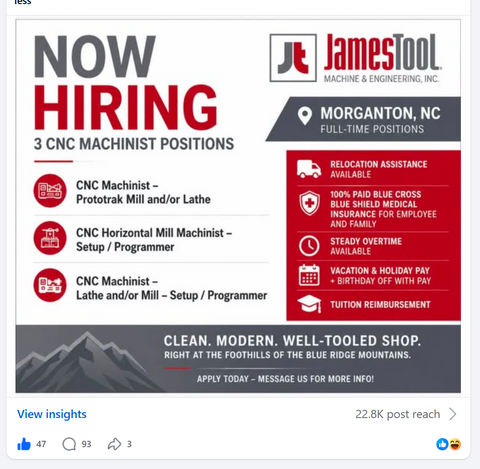
Four days in the MACHINIST group.
22,800 post reach
47 reactions
93 comments
3 shares
Three openings, in a town of 17,000 people, in front of 22,800 machinists.
1. We led with relocation, not the job title
Most job posts open with the role. We opened with a sentence about moving:
“Relocation assistance is available for qualified CNC machinists willing to move to Morganton, North Carolina.”
That one decision changes who the post is for.
Open with “CNC Machinist — Morganton, NC” and you're talking to machinists who already live near Morganton. There aren't many. And the good ones already work at the other shops in town.
Open with relocation assistance and you're talking to every machinist in the country who's unhappy where he is and has wondered if anybody would help him move.
That's a much bigger group than most shops think. And almost nobody is talking to them.
We said it again at the bottom, in case anyone missed it: “even if you're not currently in North Carolina.”
2. We named the machines
Prototrak. Horizontal mill. Lathe and mill. Setup, programming, and running.
That means nothing to an outsider. To a machinist it's the whole job.
A guy who's spent six years on a Prototrak knows in two seconds whether this is for him. A guy who's never touched one also knows, and keeps scrolling.
That's what you want. You're not paying to talk to him.
Being specific does two jobs at once. It pulls the right people in and pushes the wrong people out. “Experienced CNC machinist wanted” does neither.
It also tells a machinist that whoever wrote this has been in a shop. They can tell. They've read a thousand job ads written by somebody who's never seen a control.
3. We picked the one benefit he could check
James Tool has a good benefits package. We had to decide which piece of it goes in bold.
We picked this one:
100% paid Blue Cross Blue Shield medical insurance for employee and family.
Compare that to what most posts say.
“Competitive benefits.” “Full benefits after 90 days.” A machinist has read those a hundred times. He knows they can mean a plan that takes $600 a month out of his check for family coverage.
100% paid, employee and family, named carrier — that's a number. He can check it. Nobody can walk it back in the interview.
If he has two kids, that's worth a few dollars an hour, and he can do that math standing at the machine.
That's the difference between a benefit and a claim about a benefit.
If your shop has one thing like that, lead with it. If you're not sure which one it is, ask the last guy you hired why he took the job.
Pay works the same way, and it's the one number a machinist checks first. If you want to see where your range sits, we pulled it off our own board: what shops are actually posting for machinists.
4. We kept the small human thing
Buried in the list, between vacation pay and the shop description:
Birthday off with pay.
It's worth almost nothing. Eight hours, once a year.
It's also the line he remembers.
And it tells him something the rest of the post can't. Somebody there thought about what it's like to work there. Shops that give you your birthday off usually aren't the shops that write you up for being four minutes late.
Every job post lists pay and benefits. Almost none of them give a machinist any read on what the place is actually like.
One small human detail does more of that than a paragraph about culture.
Same goes for “clean, modern, well-tooled shop” and “right at the foothills of the Blue Ridge Mountains.” Neither one is a benefit. Both answer questions a guy thinking about moving across the country would actually ask.
This is usually the first thing that gets cut when a shop writes its own post. It shouldn't be.
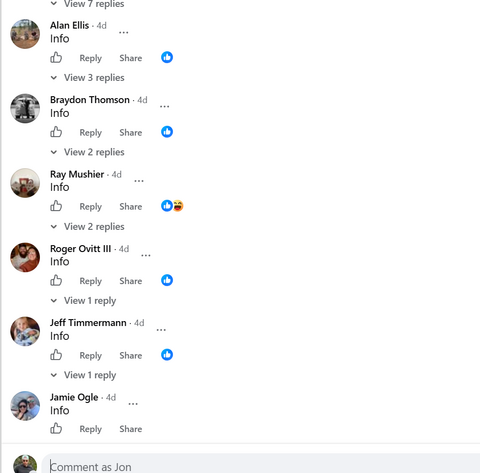
The ask was one word.
“Comment INFO below or send me a message.”
22 machinists did it. Mara answered them.
5. We made the ask one word
This is the part most shops get wrong.
We didn't say apply on our careers page. No link to a portal. No resume. No account to create.
We said:
“Comment ‘INFO’ below or send me a message.”
Think about who you're talking to. An experienced machinist. Employed. Scrolling Facebook on his phone at 9pm.
He's a little interested. He's not interested enough to go find his resume, make a login, and fill out eleven fields on a phone.
He is interested enough to type five letters.
That's where the 22 came from. Twenty-two warm conversations that cost the machinist nothing to start. The qualifying happens next, in the conversation, where it belongs. Not in a form that screened him out before you knew he existed.
Post the same job with an “apply on our website” link and you don't get 22. You get two or three, and they're the guys who were already actively looking — which is not the same group as the guys who are actually good.
6. The other 71 comments were doing a different job
Here's the part I want shop owners to understand, because it's the least obvious thing on this list.
Seventy-one of those comments weren't leads. Guys tagging a buddy. Guys asking what it pays. Guys with an opinion about North Carolina. A couple of jokes.
None of them are going to interview.
All of them helped.
Facebook decides who else sees a post based on how people engage with it, and a comment counts for a lot more than a like. Every one of those 71 comments pushed the post further into somebody else's feed. That's a real part of how three openings in a town of 17,000 people got in front of 22,800 machinists in four days.
So the one-word ask is doing two jobs at once. It captures the guys who want details, and it feeds the thing that decides how many people see it at all. Those two effects compound. More comments means more reach means more comments.
Two practical consequences.
Don't delete the noise. Shops get uncomfortable when the comments wander off topic and want to clean it up. Leave it. That conversation is buying you distribution.
And don't judge a post by the lead count alone. 93 people publicly talking about your shop is also proof, visible to everyone who scrolls past. An email application is invisible to everybody.
7. A real person answered, not a company
The post went out under Mara's name. She's the HR manager at James Tool, and she offered to answer questions about the jobs, the shop, and the move.
Then she actually did it. Almost every info request has a reply under it.
That part matters as much as the post. Twenty-two leads do you no good if nobody answers them.
For a machinist thinking about moving to a state he's never lived in, that conversation matters more than the pay range. He's got questions that aren't in the post. Schools. Cost of living. What second shift really looks like. Whether relocation help means $2,000 or real money.
He wants to ask a person. A careers portal can't answer any of that.
So if you run this play, decide before you post who's answering and how fast.
It should be somebody with a name and a face, who can talk about pay and relocation without checking with anyone. Not a shared inbox.
And it should be somebody who can reply the same night. A machinist who typed five letters at 9pm and hears nothing for three days has already moved on.
The numbers, straight
I want to be clear about what these figures prove and what they don't, because there's a lazy version of this post that just says “22,800 reach” and lets you assume the rest.
Reach is the weakest number here. We've run campaigns in the group that hit 120,000 people. Reach mostly tells you how many phones a post went past.
93 comments is the engagement number. About four tenths of a percent of everyone who saw it. That's near the top of what we see, and several times better than campaigns with five times the reach. It's what bought the extra distribution.
22 info requests is the pipeline number. That's the one a shop owner should care about. Twenty-two experienced machinists, most of them not actively job hunting, willing to have a conversation about three openings in a small town.
Twenty-two is the number I'd want if I ran the shop.
And I'm not claiming three hires. The post is four days old.
Twenty-two interested machinists isn't three filled seats. There's screening, interviews, offers, and in this case a family deciding whether to move to North Carolina.
Days-to-fill, and whether the guy is still there in six months — those are the numbers you're actually buying. It'd be lazy of me to let a reach number stand in for them.
So I'll update this post when those seats are filled, with how long it took.
What to do with this
Two things here, and they're separate.
The distribution is hard to copy. Getting a job in front of 22,800 machinists in four days isn't something a shop can do on its own, or on a general job board, or on its own Facebook page. That audience is in the MACHINIST group, and we're the only ones allowed to post jobs in it.
But the distribution isn't what produced the conversations. The writing did.
I've watched campaigns with way more reach produce far less. The difference is almost always the same short list. Lead with the thing that grows your audience. Name the equipment. Pick the one benefit he can check. Keep the human detail. Make the ask cost nothing. Leave the noisy comments alone. Have a real person answer.
You can fix your next job post on Monday without spending a dollar. Steal all of it.
It's probably the best hiring ad we've ever offered.
Four featured posts over four weeks, in a group of 622,000 machinists. We write the copy and build the graphics, because that's the half most shops don't want to do and it's the half that decides whether the post works.