If you're asking "how do I become a CNC machinist," here's the honest answer: you don't need a four-year degree, and you don't need to already know how to run a machine. You need to be willing to learn on the shop floor, show up on time, and pay attention. Everything else — the programming, the tight tolerances, the six-figure ceiling — comes with time.
I run a job board that's posted thousands of CNC jobs, and I've watched the same career path play out at shop after shop: operator, then setup, then programmer. Here's what that path actually looks like, and what each step actually pays.
The CNC Machinist Career Path, Step by Step
Most people start as an operator — loading parts, running a machine that's already programmed, checking parts with calipers or a micrometer. From there, you move into setup, where you're figuring out fixturing and offsets and getting jobs running from scratch. The top of the ladder is programming, where you're writing the code (or generating it in CAM software) that tells the machine what to do.
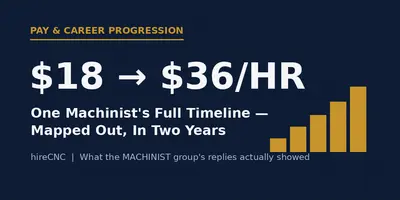
Here's what those three steps are actually paying right now, based on real wages posted on our own board — not a government survey, but real numbers from real employers hiring right now (based on 261 real job postings):
Operator: $23.50/hr median
Setup: $33.00/hr median
Programmer: $39.75/hr median
That's real money for people willing to put in the time. For context, our board runs noticeably higher than the national median — the U.S. Bureau of Labor Statistics puts the median machinist wage about $28.25/hour nationally.
How People Actually Get Started
There's no single path in the door. The three most common ones I see:
Hired in as a green operator and trained on the job. Plenty of shops will take someone with zero machining experience if you show up reliable and mechanically inclined. You start on simple, repetitive work and earn your way onto more complex jobs.
A community college or technical school machining program. These usually run anywhere from a few months to two years and teach you blueprint reading, basic G-code, and hands-on machine time before you ever apply for a job. It's the fastest way to walk in already knowing the basics.
A formal apprenticeship. Some larger shops and manufacturers run structured apprenticeship programs that combine paid on-the-job training with classroom instruction, often through a local community college or union.
None of these paths is "better" — it mostly comes down to what's available near you and whether you'd rather start earning right away or spend a few months in a classroom first.
Certifications Worth Having
You don't need a certification to get hired as an entry-level operator. But if you want to stand out, or you're aiming to move up faster, a couple of credentials carry real weight with employers:
NIMS credentials (National Institute for Metalworking Skills) are the closest thing our industry has to an industry-standard certification, covering everything from measurement and inspection to CNC milling and turning.
A machine-specific certificate from a community college program shows an employer you've already got real hands-on time on a mill or lathe, not just classroom theory.
Beyond formal certifications, the thing that actually gets you promoted is proving you can run a job start to finish without someone standing over your shoulder — that's what earns you a shot at setup, and eventually programming.
What Actually Moves You Up
Talk to shop owners and the answer is pretty consistent. The machinists who move up fastest are the ones who:
Learn to read blueprints and GD&T (geometric dimensioning and tolerancing) well enough to catch problems before they become scrap.
Get comfortable with CAM software (Mastercam, Fusion 360, and similar) instead of relying only on hand-written G-code.
Take ownership of quality — checking their own work instead of waiting for inspection to catch mistakes.
Show up and show initiative. It sounds simple, but reliability is still the single biggest thing that gets someone noticed for the next opportunity.
Master those, and the jump from operator to setup to programmer isn't really a mystery — it's just a matter of time.
A young machinist asked our MACHINIST Facebook group whether to leave a mass-production shop for a small aerospace job shop. Here's what experienced machinists told him, and what to ask before you make the same move.
A machinist asked why he was only offered $24/hr after five years. The post got 800+ replies with no consensus — here's what actually explains the pay spread, backed by real hireCNC board and BLS data.